Retail CX & E-commerce UX Case Study: IKEA SUNNERSTA

Turning modular kitchen shopping from a puzzle into a one-click solution.

Redesigning the SUNNERSTA digital acquisition journey, from fragmented catalogue to four persona-driven bundle architectures, eliminated critical purchasing errors and compressed average time-to-basket by over 80% in prototype testing.

SUNNERSTA  ·  IKEA Marketing & Communication, Älmhult
Interior Design Manager + Creative Lead  ·  2020

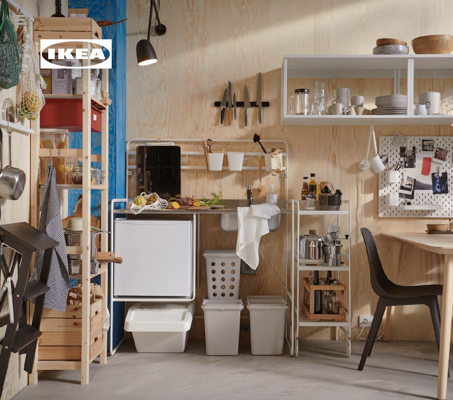
SUNNERSTA is IKEA's modular kitchenette system: a freestanding, fully configurable range designed for compact spaces and constrained budgets. Its proposition is genuinely strong: a functional kitchen that can be assembled without tools, reconfigured for any footprint, and taken apart when the tenancy ends. It serves a real and growing European market of students, young professionals, renters mid-renovation, and anyone who needs a working kitchen where a permanent one cannot go.

The product worked. The digital experience around it did not. As Creative Lead within IKEA Marketing and Communication in Älmhult, I was asked to lead a one-month service design sprint to investigate why a product with clear demand and genuine utility was generating friction, abandonment, and post-purchase failure at scale across the digital acquisition journey.

Validated
N

Need

Demand for compact, affordable, tool-free kitchen solutions is real and growing across European rental markets. The need signal was unambiguous.

Validated
S

Solution

SUNNERSTA as a product is strong: modular, configurable, genuinely suited to the spaces and budgets it targets. The physical solution was not the problem.

Broken
B

Business Architecture

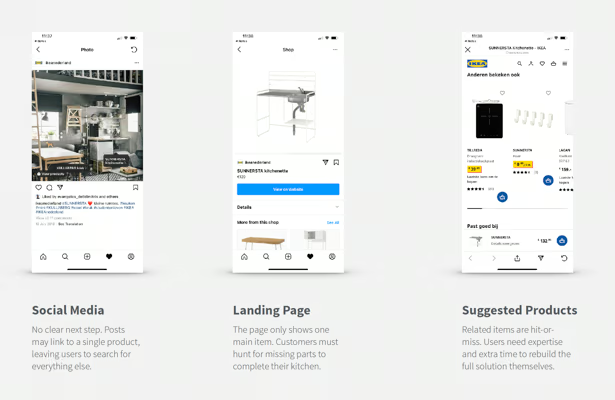
The digital acquisition architecture was fragmented at every stage. Social, landing page, and suggested products each operated as isolated dead-ends, forcing users to act as their own systems integrators with no guidance and no safety net.

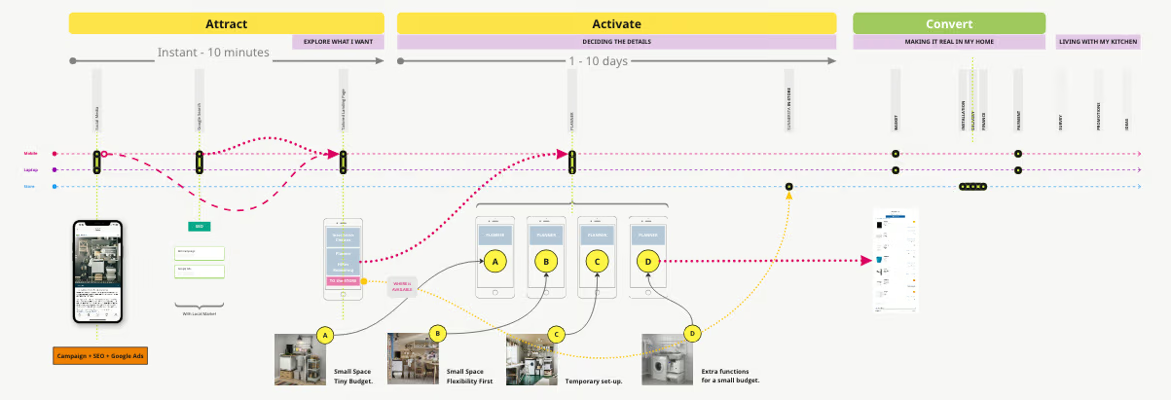
Customer journey analysis revealed three distinct failure points, each compounding the next. Social media posts linked to a single component, leaving users to manually hunt the full catalogue for everything else. Landing pages displayed only the core frame, requiring a level of product expertise that most buyers did not have and should never have needed. Suggested products were algorithmically generic rather than contextually matched: users who needed a sink strainer to make the product functional found themselves either missing it entirely or abandoning the session to research on third-party forums. The product was complete. The path to owning it was not.

The digital experience forced the customer to act as the systems integrator for a product that had already been designed to be simple.

The intervention began with customer journey mapping across the full SUNNERSTA acquisition path: from social discovery through landing page to checkout. Rather than auditing the product, I audited the experience of buying it. What the mapping revealed was not a single failure but a sequence of disconnections, each one transferring cognitive work that should belong to the platform onto the customer. The first decision was therefore not to redesign a page but to redesign who carries the burden of compatibility. The answer had to be: the system, not the buyer.

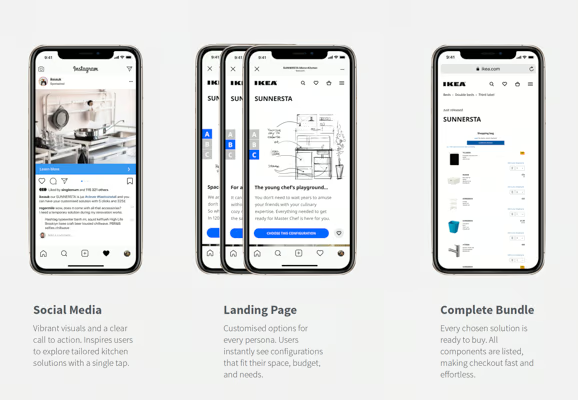
With a UX researcher and an interior designer, I then built four persona profiles mapped against real European living contexts: a London student in a bedsit (small space, minimal budget), a Paris artist in a studio (small space, flexibility first), a Madrid family mid-renovation (temporary set-up, plug-and-play priority), and a Berlin user fitting out a secondary space (extra functions, small budget). Each persona had a different compatibility matrix, a different emotional state at the point of purchase, and a different definition of what a complete solution looked like. The work was to pre-compute those matrices and embed them in the experience before the customer arrived.

The output was a three-layer digital architecture. Social channels were redesigned to route directly into persona-matched landing pages rather than single-product pages, turning inspiration into a directed entry point. Each landing page presented a pre-configured, one-click bundle validated for that specific context, with every mandatory component included and every accessory relevant to that use case offered as a clear upsell. The catalogue ceased to be the interface. The bundle became the interface. Web, social, and the complete bundle checkout were designed as a single connected system, not three separate surfaces.
>80%

Reduction in time-to-basket

Prototype testing across four persona scenarios · avg. 9.4 min baseline to 1.8 min prototype

0%

Critical component omission rate

Mandatory plumbing parts (strainer, faucet) missing from basket · down from 68.5% in baseline

~40pp

Drop in cart abandonment

Directional result across all four persona tests · consistent with Baymard Institute one-click benchmark of 31–35%

4

Persona-matched bundle architectures delivered

Each pre-computing a distinct compatibility matrix · 1-month sprint · team of three

Does your situation have a gap like this?

The diagnostic is where every engagement begins. A bounded, de-risked initial conversation to map the real state of Need, Solution, and Model.

Start a Conversation